Neuro-narratives

I chanced upon this rather turgid article that claims there is now a new sub genre of literature. The writer coins the label “Neuronarratives” to denote works of fiction that incorporate advances in cognitive studies. The writer takes the “two cultures” debate as the organizing theme in the two novels under consideration. One of the books that he refers to that I have read is David Lodge’s Thinks . . . Another novel that I’ve read but is not referenced is Dan Lloyd’s Radiant Cool.

Both novels are written by university insiders: the former makes all-knowing play of the incestuous culture of universities, the protagonist being a Dennett-like character (intellectually, not in a personal sense). In effect, this novel is fluff: the neuro content is incidental and is merely used as a device to make the novel seem current and the writer deep. The latter is actually a work of philosophical imagination – and not surprisingly was written by a philosopher. Having recently read John Casti’s The Cambridge Quintet: A Work of Scientific Speculation which scans the history of AI and consciousness over the last 50 years, I am of the view that these novels fall under the rubric of “novels of ideas” and do not constitute a new genre – there is no plausible collecting feature to denote a sub genre.

Perspectives on Social Cognition

Here is the fully published special issue of Cognitive Systems Research
Volume 9, Issues 1-2, March 2008

  2. Introduction to the special issue “Perspectives on Social Cognition”
Cognitive Systems Research, Volume 9, Issues 1-2, March 2008, Pages 1-4
Leslie Marsh and Christian Onof
 
  3. Functionalism and mental boundaries
Cognitive Systems Research, Volume 9, Issues 1-2, March 2008, Pages 5-14
Lawrence A. Shapiro
 
  4. Consciousness and the social mind
Cognitive Systems Research, Volume 9, Issues 1-2, March 2008, Pages 15-23
Philip Robbins
 
  5. Social relationships and groups: New insights on embodied and distributed cognition
Cognitive Systems Research, Volume 9, Issues 1-2, March 2008, Pages 24-32
Eliot R. Smith
 
  6. A conceptual and empirical framework for the social distribution of cognition: The case of memory
Cognitive Systems Research, Volume 9, Issues 1-2, March 2008, Pages 33-51
Amanda J. Barnier, John Sutton, Celia B. Harris and Robert A. Wilson
 
  7. Dynamic empathy: A new formulation for the simulation theory of mind reading
Cognitive Systems Research, Volume 9, Issues 1-2, March 2008, Pages 52-63
Teed Rockwell
 
  8. The social-cognitive dynamics of metaphor performance
Cognitive Systems Research, Volume 9, Issues 1-2, March 2008, Pages 64-75
Raymond W. Gibbs Jr. and Lynne Cameron
 
  9. Frege’s puzzle and Frege cases: Defending a quasi-syntactic solution
Cognitive Systems Research, Volume 9, Issues 1-2, March 2008, Pages 76-91
Robert D. Rupert
 
  10. Cultural-historical activity theory and the zone of proximal development in the study of idioculture design and implementation
Cognitive Systems Research, Volume 9, Issues 1-2, March 2008, Pages 92-103
Robert Lecusay, Lars Rossen and Michael Cole
 
  11. The cultural evolution of socially situated cognition
Cognitive Systems Research, Volume 9, Issues 1-2, March 2008, Pages 104-114
Liane Gabora
 
  12. Economics, cognitive science and social cognition
Cognitive Systems Research, Volume 9, Issues 1-2, March 2008, Pages 125-135
Don Ross
 
  13. Stigmergic epistemology, stigmergic cognition
Cognitive Systems Research, Volume 9, Issues 1-2, March 2008, Pages 136-149
Leslie Marsh and Christian Onof
 
  14. Methodological situatedness; or, DEEDS worth doing and pursuing
Cognitive Systems Research, Volume 9, Issues 1-2, March 2008, Pages 150-159
Joel Walmsley

Science Wars Revisted

Just the other day I was conversing with a biochemist friend of mine who works in R&D. We were discussing the entrenched attitude to science that still seems to prevail 12 years on from the so-called “Science Wars” of the mid-90s. On the one hand, there is a schizophrenic attitude emanating from the humanities and the social sciences:

1. that the truth-value of science is “merely” relative, generated by an uncritical constructivist viewpoint.

Counterposed by,

2. the incorporation of a low grade understanding of science that is appealed to almost as a form of intellectual “penis envy”.

On the other hand, it doesn’t of course help that scientists’ self-promotion in the perpetual chase for funding, is characterised by hyperbole of enormous proportion, further vitiated by journalists who then in turn embarrass any genuine research by coming up with snappy headlines that bare only faint resemblance to what was being claimed.

Anyway, I notice that Alan Sokal (he of the so-called “Sokal Hoax“) has a new book  just about to come out. I look forward to getting his take with the passing of the interim years. Indeed, one of the motivations behind my setting up of the journal of social epistemology, EPISTEME, was motivated by Sokal – I wanted to create a forum that could take the heat out of this bitterest of debates.

Robots

sciam_special-robotics.jpg


The Volume 18, Number 1 issue of Scientific American Reports is a special edition on robotics. The following articles feature:

 1. Bill Gates’s “A Robot in Every Home” concentrates on such commonplace items as the vacuum cleaner and not the exotic anthropomorphous robots of the popular imagination.

2. Hans Moravec’s “Rise of the Robots” does discuss issues facing artificial intelligence.

3. Ray Kurzweill’s “The Coming Merging of Mind and Machine” oozes a techno-ebullience about neural implants and the processing power of chip development. He then takes a philosophical turn by discussing whether by 2020 when a $1,000 computer is expected to match the processing power of the human brain, will it be conscious?

4. The highlight of the issue is the ever reliable Eric Bonabeau and Guy Theraulaz, the doyens of Swarm Theory. Their article “Swarm Smarts” summarizes how their work, inspired by social insects, finds practical application in solving issues arising from complexity.

5. Moshe Sipper and James Reggia discuss the notion of self-replicating (and self-repairing) machines.

6. Miguel Niclelis and John Chapin’s article “Controlling Robots with the Mind” picks up where Kurzweill left off. The idea of brain-machine interface in a very intimate way, is fascinating.  

The rest of the issue is devoted to a variety of engineering issues and progress in hardware and materials functionality. For those who are interested in the philosophical issues that underlie all these articles I’d recommend John Casti’s The Cambridge Quintet. Casti offers a fictionalized account of the meeting convened by C.P. Snow – a dinner discussion with Turing, Haldane, Schrodinger and Wittgenstein –  a narrative device to hang discussion of the philosophical issues of artificial intelligence on  and present it in a highly accessible manner. If you liked David Lodge’s Thinks . . . you’ll probably like this.

Regarding the above SAR issue it seems to me that Andy Clark would have been a wonderful addition to the lineup – Clark is someone who has a fascination with cyborgs, is a great popularist and is very philosophically literate. Clark would have been the ideal person to give a deeper editorial coherence to this issue. Still there is the super art work of Mondolithic Studios offsetting any editorial shortcomings – the photo above is a variation of the photo that actually appears on the cover. 

Naturalizing Religion

I notice that Oxford’s Ian Ramsey Centre for Science and Religion and the Centre for Anthropology and Mind have received a big grant for the “study of the cognitive science of religion” from the Templeton Foundation. Who’d have thought that the project of naturalizing religion would become so sexy – for reasons I won’t go into, this couldn’t have happened just 10 years ago when I was at Oxford. Writers engaged in this project that I have written on or, will soon be writing on, include Dennett, Rue and Flanagan.

Free Content Access to EPISTEME

To promote Edinburgh University Press’s new content management system, the  Press is offering free access to EPISTEME until the end of March. See here.

Minds and Societies

Social cognition is this year’s theme at the Summer Institute in Cognitive Science at Université du Québec à Montréal.

Anti-Individualism

Though I haven’t yet read Sandy Goldberg’s brand new book Anti-Individualism: Mind and Language, Knowledge and Justification I do look forward to doing so. I’d be interested to how Sandy’s work differs from Jessica Brown’s Anti-Individualism and Knowledge of a few years ago.

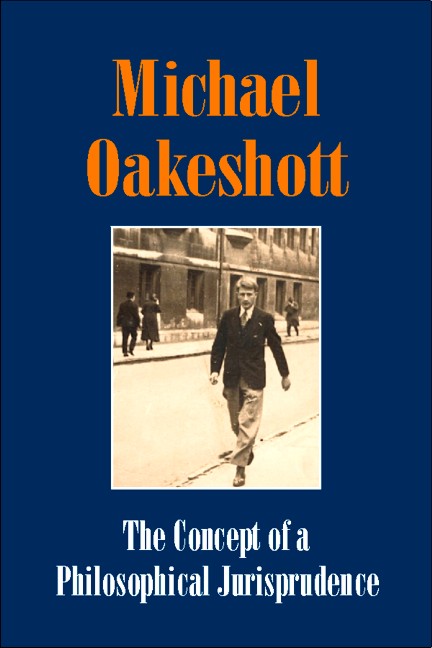
The Concept of a Philosophical Jurisprudence

cpj.jpg

Oakeshott’s great essay “The Concept of a Philosophical Jurisprudence” is now available in book form. For several years prior to the opening up of the LSE Oakeshott archives, this essay was being passed around in photocopy form, a copy of a copy etc . . . making it ever harder to read. Whatever else is in this collection, this essay alone justfies the cost of this volume: this is an essay that should be read by any serious student of Oakeshott’s work.