Browse by:

Hayek’s Post-Positivist Empiricism: Experience Beyond Sensation

The intro from Jan Willem Lindemans’ paper: The philosophical foundations of Hayek’s works are not beyond dispute (Gray, 1984, Kukathas, 1989, Caldwell, 1992, Hutchison, 1992): was Hayek a rationalist or an empiricist; did he follow Kant or Hume, Mises or Popper? Difficulties arise because these questions touch upon social theory, political philosophy, methodology and epistemology.…
Rationalism in Politics

In anticipation of a talk I’m giving later on in the week on Oakeshott’s so-called “dispositional conservatism”, here is a nice little piece by my chum Gene Callahan serving as a good introduction to RIP. The British philosopher and historian Michael Oakeshott is a curious figure in twentieth-century intellectual history. He is known mostly as…

Turing Centenary

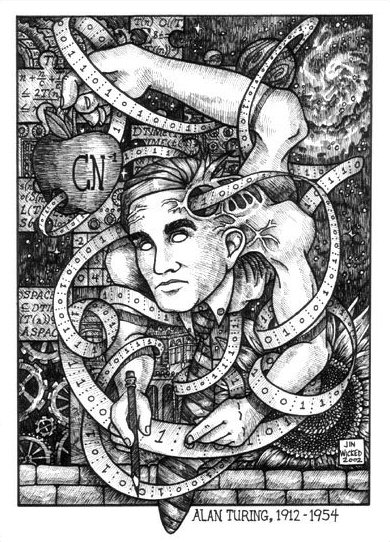
Conference page. Here is also one of Turing’s most famous papers: I propose to consider the question, “Can machines think?” This should begin with definitions of the meaning of the terms “machine” and “think.” The definitions might be framed so as to reflect so far as possible the normal use of the words, but this…

The Emergence of the Mind: Hayek’s Account of Mental Phenomena as a Product of Spontaneous Physical and Social Orders

Gloria Zúñiga y Postigo’s intro from her excellent paper. Friedrich Hayek’s social theory is well known for his articulation of the paradigm of spontaneous orders that challenges the traditional distinction between what is natural and what is artificial. The problem that Hayek saw is that language and other social objects do not fall under either…

Extending the mind

Three luminaries – Rob Rupert, Richard Menary and Jonno Sutton – discuss the topic on Australia’s Radio National The Philosopher’s Zone. P.S. H/T to Ken Aizawa for bringing Rupert’s review of Clark to our attention. BrainCognitionCognitive neuroscienceCognitive scienceEmbodied cognitionExtended Mindphilosophical psychologyPhilosophyPhilosophy of mindRichard MenaryRob RupertRobert Rupert

C. S. Peirce and F. A. Hayek on the Abstract Nature of Sensation and Cognition

Here is the intro to Jim Wibble’s fascinating paper, the full version available here. When exploring ideas on philosophy of science and economic methodology, one of the most unusual articles that one can encounter is Hayek’s well-known piece, “The Primacy of the Abstract”. In a note in the article, Hayek tells us that he had…

Hayek’s Self-organizing Mental Order and Folk-Psychological Theories of the Mind

Here is the Introduction to Chiara Chelini’s paper, the full version available here. Humans are social creatures and they deeply rely on mentalizing, which aims at understanding other people behaviours and formulating expectations about their future actions. The existence of inner mental states has been postulated in order to give an explanatory account of the…