Browse by:

Hayek in Today’s Cognitive Neuroscience

Check out Joaquín Fuster’s recent paper: Only now, more than half a century after the publication of his theoretical book (Hayek, 1952), is the reaction to Hayek’s argument beginning to be heard. And it’s a positive reaction, now supported by facts. He used to say that without a theory the facts are silent. Now, belatedly reacting to…

Can science ever explain consciousness?

Anil Seth, Chris Frith and Barry Smith (of Birkbeck, not Buffalo!) outline the topography in a podcast. Anil SethBarry SmithChris FrithCognitionCognitive neuroscienceCognitive sciencecomplexityconsciousnessEmbodied cognitionMagnetic resonance imagingneurosciencePhilosophy of mindqualia

Colin McGinn: All machine and no ghost?

Colin McGinn locates his position within philosophy of mind. Though not a fashionable position, I’m very sympathetic to it – and of course, it is a position that has much in common with Hayek. The “mysterianism” I advocate is really nothing more than the acknowledgment that human intelligence is a local, contingent, temporal, practical and…

Remembering Varela

Four articles (and more) of interest to theorists interested in enaction: 1. Tom Froese’s new article in Adaptive Behavior: Critics of the paradigm of enaction have long argued that enactive principles will be unable to account for the traditional domain of orthodox cognitive science, namely “higher-level” cognition and specifically human cognition. Moreover, even many of the…

Colin McGinn on Philosophy of Mind

McGinn, one of my favourite philosophers of mind, notwithstanding Dennett’s view of McGinn’s well-known position: In the Critics section of this week’s New Statesman, ten pages of which are devoted to a philosophy special, our Critic at Large is Colin McGinn, professor of Philosophy at the University of Miami, who surveys the current state of…

Remembering Herbert Simon

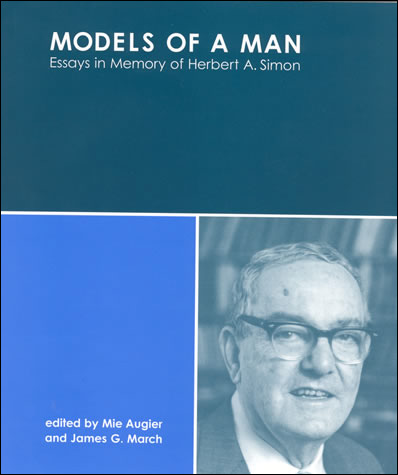
Simon died this day in 2001. Check out these two books – Models of a Man (as with most edited books this is uneven, but there is still much to recommend it) and Herbert A. Simon: The Bounds of Reason in Modern America, an excellent intellectual biography. Speaking of Simon, I have a paper coming out entitled…