Thomas Scanlon in the Boston Review on “How Not to Argue for Limited Government and Lower Taxes“
Rationalism in Politics in Hebrew: מייקל אוקשוט הרציונליזם בפוליטיקה
Efraim Podoksik has just had his Hebrew translation of Oakeshott’s Rationalism in Politics published. This initiative must have taken some doing since Oakeshott was such a great stylist. So far as I know, the lead essay and/or the whole book has been translated into French, Spanish, Polish and Chinese.
Here is the contents/intro/index.

מייקל אוקשוט
הרציונליזם בפוליטיקה
The Essence of Christianity
Scanning my bookshelf I chanced upon Feuerbach‘s The Essence of Christianity. Though hardly a Marxist nor indeed much of a Hegelian, I do recall that the book had an immense effect upon me (25 years ago) – and of course, translated for the Anglophonic world by none other than George Eliot – that alone impressed me. I made a point of finding her grave at Highgate on my trip to London earlier this year. I’m not sure what I’d make of the book now, but I recall that it certainly carried a heavy punch.
Empathy: Philosophical and Psychological Perspectives
Check out this volume about to be released. Here is Jesse Prinz’ contribution “Is Empathy Necessary for Morality?“
Michael Oakeshott Memorial Lecture: Oliver Letwin
Speaking of Oakeshott, today marks the opening of the Oakeshott conference in Tulsa marking 10 years since it all began.
Stigmergy and the Wealth of Networks
John Graves shares his worth with Wiki-to-Text and Stigmergy & Wealth of Networks for a Learning2gether session.
The Glass is Half Full: Optimism and the Brain
Here’s an article from Nature Neuroscience that is getting a lot of attention. Here is an interview with lead author Tali Sharot who has cornered the market on “optimism” research.
Christianity and the Extended-Mind Thesis
Here is a paper by Lynne Rudder Baker entitled “Christianity and the Extended-Mind Thesis” continuing the theme of extended mind and religion she wrote on for a symposium I put together a few years back – see the journal Zygon.
Utilitarians are not nice people
Here’s an article entitled “Goodness has nothing to do with it” in The Economist. Here is Bartels’ and Pizarro’s actual paper published in Cognition.
Chuck Getchell
On the eve of the 10th anniversary conference of the founding of the Michael Oakeshott Association (regretably I’m unable to be in attendance) I thought I’d pay tribute here to someone who was instrumental in setting up the MOA – “Chuck” Getchell. It just so happens that it’s been almost a year since Chuck died – here is his obituary.
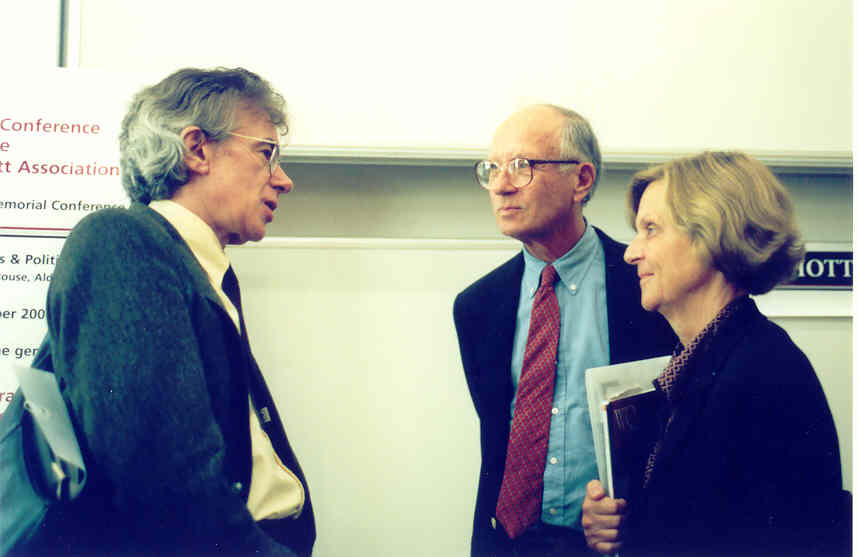
Chuck centre, flanked by Noel and Margot O’Sullivan at the Inaugural Conference in 2001 at the LSE
Chuck was an incredibly well-connected, cultured, gentle and modest guy with a twinkle in his eye. After meeting him in 2001 I came to know Chuck quite well as the long time secretary of the Sabre Foundation. I have fond memories of Chuck visiting me at my house in Maine and of my coming down to his neck of the woods in Ipswich where I met a few of his relations and was shown around the area. Chuck will be missed by many.

