Browse by:

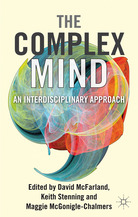
The Complex Mind

This book features a chapter by Andy Clark entitled: How to Qualify for a Cognitive Upgrade: Executive Control, Glass Ceilings, and the Limits of Simian Success. Here is the intro to the chapter: 10.1 Introduction It is sometimes suggested that words and language form a kind of ‘cognitive niche’ (Clark, 1998, 2005, 2006, 2008; Chapter…

Riders on the storm

Riders on the storm Riders on the storm Into this house we’re born Into this world we’re thrown Like a dog without a bone An actor out alone Riders on the storm There’s a killer on the road His brain is squirmin’ like a toad Take a long holiday Let your children play If ya…

Deep Cuts from Oakeshott Companion

This from David Boucher’s The Victim of Thought: The Idealist Inheritance: Idealists and realists were not as antagonistic toward each other as is commonly thought. Harold Joachim, for example, submitted the second chapter of The Nature of Truth to his “friend Bertrand Russell” before the book was published. R. G. Collingwood was a respected figure internationally…

Socrates on Trial

I want to give a plug to my chum Andrew Irvine’s play Socrates on Trial. Of perennial interest it is a way of communicating important ideas in an accessible but compelling way. Here is a dedicated page with video footage and reviews. Andrew IrvineAristophanesAthensPlatoSocratesSpartaXenophon

Steely Dan and Martinis

Ed Feser has another terrific earlier posting on Steely Dan (I recently brought attention to this one). Ed engages with Roger Scruton’s analysis of “popular” music. In older musical traditions, the focus was on the music itself, which had only a contingent relationship to the performer even when the performer was the one who composed it .…

A brain in a vat cannot break out: why the singularity must be extended, embedded and embodied

Here is a pre-published version of Francis Heylighen’s paper from JCS Abstract: The present paper criticizes Chalmers’s discussion of the Singularity, viewed as the emergence of a superhuman intelligence via the self-amplifying development of artificial intelligence. The situated and embodied view of cognition rejects the notion that intelligence could arise in a closed ‘brain-in-a-vat’ system, because…