Browse by:

Walker Percy Wednesday 80

You should be interested! Such a quest serves God’s cause! How? Because the Good proves nothing. When everyone is wonderful, nobody bothers with God. If you had ten thousand Albert Schweitzers giving their lives for their fellow men, do you think anyone would have a second thought about God? Or suppose the Lowell Professor of…


Academic Freedom in an Age of Conformity

Academic Freedom in an Age of Conformity: Confronting the Fear of Knowledge. Universities, once at the forefront of campaigns for intellectual liberty, are now bastions of conformity. This provocative book traces the demise of academic freedom within the context of changing ideas about the purpose of the university and the nature of knowledge and is a passionate…

The Death and Life of Great Italian Cities

Abstract: The Death and Life of Great American Cities was written in 1961 and is now one of the most influential book in city planning. In it, Jane Jacobs proposed four conditions that promote life in a city. However, these conditions have not been empirically tested until recently. This is mainly because it is hard…

Tony Visconti

Tony Visconti really was the natural heir to George Martin. Check out Tony’s thoughts on the state of the music industry — there is no-one as distinguished and so able to offer the ultimate insider’s diagnosis on the malaise of creativity that we know has well and truly flattened the creative landscape over the past 20…

From Bounded Rationality to Expertise

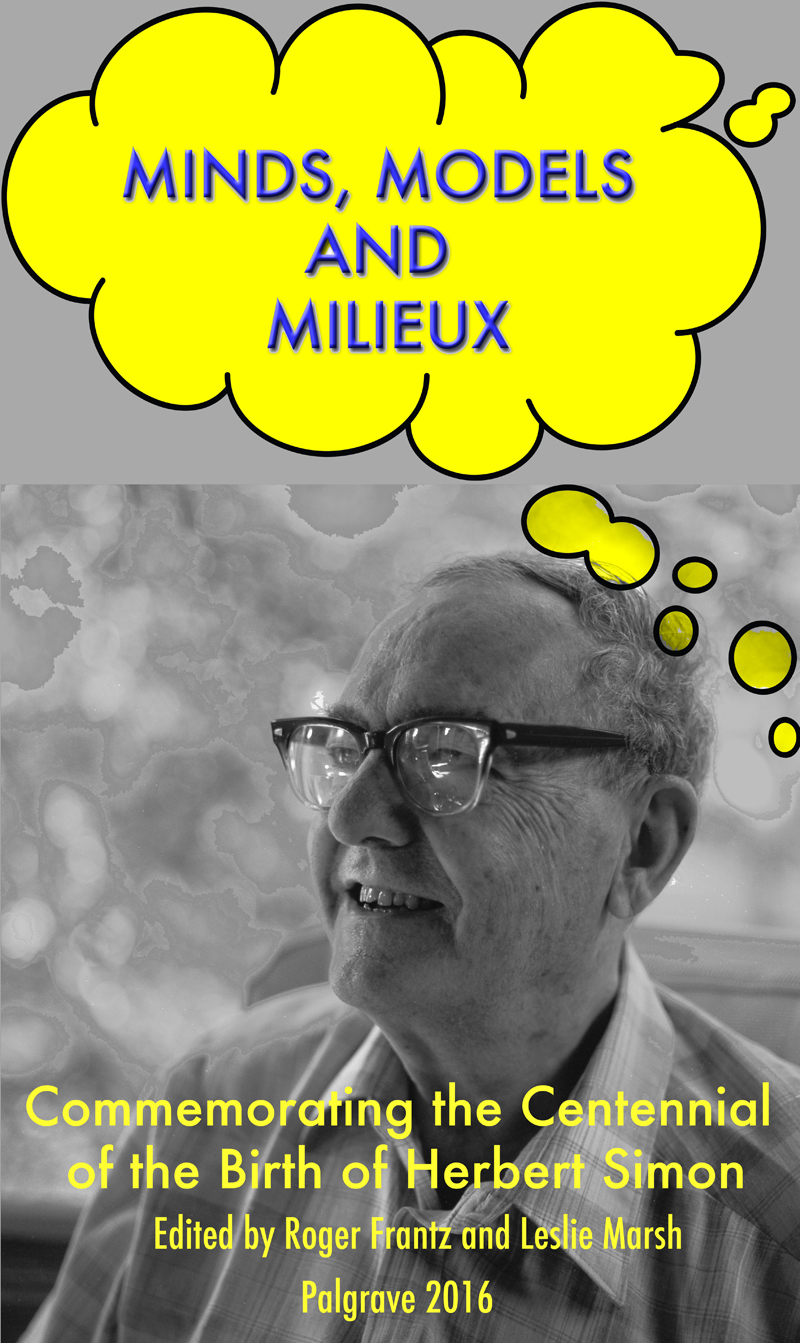
The ninth in a series of excerpts from Minds, Models and Milieux: Commemorating the Centennial of the Birth of Herbert Simon. Fernand Gobet Introduction Historically, a pervasive assumption in the social sciences, in particular economics, is that humans are perfect rational agents. Having full access to information and enjoying unlimited computational resources, they maximise utility when…

Walker Percy Wednesday 79

At least in Louisiana we knew how to take things easy. We could always drink. ***** Then I realized why I drank and smoked. It was a way of dealing with time. What to do with time? A fearful thing: a human body of ten billion cells ready to do any one of ten billion…

Social Cognition, Artefacts, and Stigmergy Revisited: Concepts of Coordination

Here’s an extract from the fifth article by Tarja Susi from this special Human-Human Stigmergy issue Some years ago Susi and Ziemke (2001) made a comparative analysis of social/situated theories of cognition (activity theory, situated action, and distributed cognition) and stigmergy, discussing the coordination paradox, visible in both social insects and human activities. The key elements compared were agents,…