Browse by:

Jazz as conversation

Jesse Norman, a prominent Oakeshottian, has this article in The Independent on “Pops’” autobiography which I too have recently read. The conceptual overlap between Jazz and the Oakeshott notion of conversation is uncannily similar. I couldn’t express my reaction to “Pops’” autobiography any better than Jesse: The book is peopled by a vast Runyonesque array of…


Oakeshott on the Character of Religious Experience: Need There be a Conflict Between Science and Religion?

Here is the intro from Tim Fuller’s essay from Zygon. Michael Oakeshott rarely acknowledged specific intellectual debts. In Experience and Its Modes (1933), however, he cited as major influences on his thinking G. W. F. Hegel’s Phenomenology of Spirit (1807) and F. H. Bradley’s Appearance and Reality (1893). Oakeshott was invoking the tradition of Hegelian/British idealism,…

Religion and the Mode of Practice in Michael Oakeshott

Here is the intro to Elizabeth’s essay: Michael Oakeshott’s religious view of the world stands behind much of his political and philosophical writing. Yet it is difficult to get a firm grasp on what religion means to Oakeshott. His ideas about it constitute nothing that most people would recognize as religious. He rarely writes about God,…

Oakeshott Symposium on Science and Religion

This is the first of six contributions to a symposium published in Zygon, vol. 44, no. 1 (March 2009). Abstract. This paper introduces a symposium discussing Michael Oakeshott’s understanding of the relationship of religion, science and politics. Essays by Elizabeth Corey, Timothy Fuller, Byron Kaldis, and Corey Abel are followed by a review of Corey’s recent…

Companion Luncheon Launch

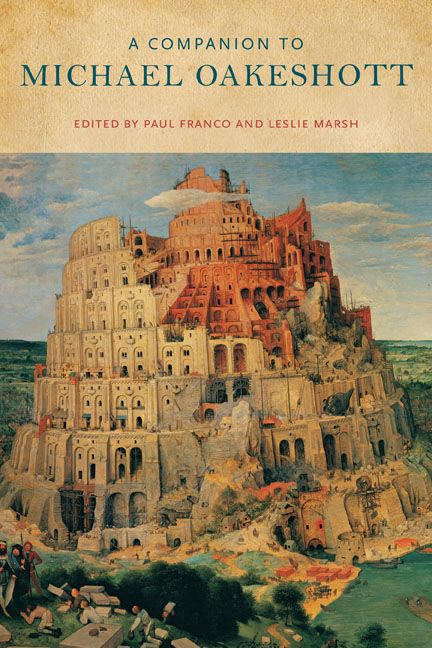
Thanks to Corey Abel, Paul Franco, Steven Gerencser, Ken McIntyre and Ken Minogue, five of the Companion’s contributors, all of whom did such a sterling job of expressing to the assembled audience why Oakeshott is such a worthwhile thinker. Thanks also to our AHI hosts Bob Paquette and Thomas Cheeseman. a companion to michael oakeshottMichael…

Marsalis and Oakeshott on conversation

Wynton Marsalis: Great jazz requires a strange alchemy of instinct and expertise, of empathy and teamwork from its musicians Jazz teaches you how to be a person, and how to ripen your personhood through empathy Michael Oakeshott from The Voice of Poetry in the Conversation of Mankind: Conversation . . . was . . . the very…

Oakeshott on Law

The last essay in the collection. To write about law in relationship to Michael Oakeshott’s ideas generally, or his thoughts on politics in particular, presents a complicated task, not because law is an obscure concept in Oakeshott and not because it is a topic about which he has written little. In fact, Oakeshott wrote about…