Browse by:

Oakeshott on the History of Political Thought

Martyn’s essay opens the second half of the Companion. The fact that nonhistorical elements were interwoven into the lecture course strongly suggests that Oakeshott was doing something other than offering his students an outline history of Western political thought. And this suggestion is in part confirmed by the fact that Oakeshott’s own title for the…
Oakeshott on Education

Here are some extracts from my co-editor Paul’s essay. Toward the end of his essay on “The Universities,” Oakeshott returns once more to the issue of specialization, this time in a less polemical, more thoughtful manner. Though he believes that Moberly has exaggerated the problem, he nevertheless acknowledges that the disintegration of the world of…

Oakeshott on Aesthetic Experience

Excerpts from Corey Abel’s essay on aesthetics Commentators agree that “The Voice of Poetry” is important but disagree on whether Oakeshott wrote a theory of aesthetics. Most think “The Voice of Poetry” establishes poetry’s distinction from practice, as it does, forcefully. But in his remarks on childhood, friendship, and love, Oakeshott seems to rejoin poetry…

Companion to Oakeshott Official Launch

The Penn State Companion will have its official launch as part of a colloquium sponsored by The Alexander Hamilton Institute and Colgate’s Center for Freedom & Western Civilization. The colloquium format will be Liberty-style except that there will be an audience. For those able to attend, you will be most welcome. The dates: Thur, April…

The Religious Sensibility of Michael Oakeshott

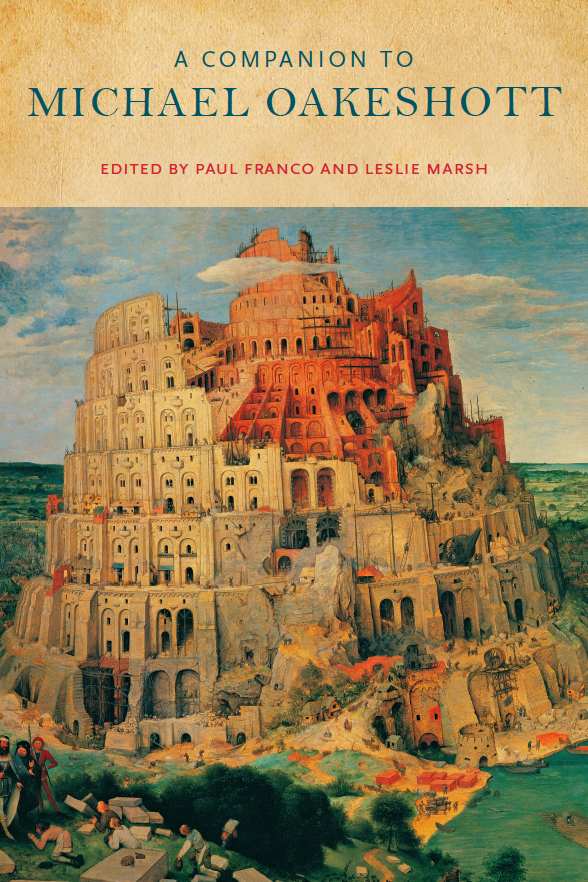
Snippets from Elizabeth Corey’s essay: Perhaps what is most notable about the Tower of Babel myth, in both of Oakeshott’s essays, is the perfectionism inherent in the story. Whether one wants to contribute to a great and noble cause or to change the world through human action, pride and overestimation lie at the center of…

Michael Oakeshott’s Philosophy of History

Here are some extracts by the man who first set me on the road to Oakeshott some twenty years ago – Geoff Thomas. Geoff has a philosophy of history book coming out soon – and I can tell you it’s a cracker. What Oakeshott said about history—his canonical philosophical view about the nature of historical inquiry—can…

Philosophy and its moods

These excerpts from Ken McIntyre’s essay Philosophy and its moods: Oakeshott’s insistence on the dispositional skepticism of philosophical activity leads to his rejection of both the importance of authority in philosophy and the relevance of philosophy to practical life. He writes that philosophy “recognizes neither ‘authorities’ nor ‘established doctrines,’” because such institutions present themselves as conclusions…

Deep Cuts from a Companion to Oakeshott

This is the first in series of extracts that caught my eye while rereading the Companion. The following is from Bob Grant’s chapter The Pursuit of Intimacy, or Rationalism in Love: But Michael was the least materialist, or materialistic, of men. He always believed in the “otherworld” and also that, like Kant’s realm of freedom, it…

A Companion to Michael Oakeshott

After a four year gestation with many, often quite bizarre twists and turns, today this project officially reaches its fruition. To read excerpts from each chapter, type “oakeshott” into this site’s search box. a companion to michael oakeshottBritish Idealismdead philosophersMichael OakeshottOakeshottPhilosophy of historyphilosophy of social sciencePolitical philosophyThomas Hobbes

Philosophy and its Moods: Oakeshott on the Practice of Philosophy

Extract from Ken McIntyre’s chapter: Among non-academic intellectuals and political theorists, Michael Oakeshott is known primarily as a conservative political thinker who produced a series of essays in the 1950s which were critical of “rationalist” or “ideological” politics. Others who have read more deeply in Oakeshott’s corpus are aware of his contributions to the philosophy…