Browse by:

Hayek in The Stanford Encyclopedia of Philosophy

It’s about time that Hayek had a dedicated entry in the SEP. I’ve been “lobbying” for FAH’s inclusion for some time now. Here is the stated brief of the article: This essay concentrates on this enduring theme [spontaneous order] of Hayek’s work, and a question: why would the scholar who did more than anyone in the…
Constructivist and Ecological Rationality in Economics

All those interested in extended mind/externalist/situated type thought should be aware of the field of Behavioral Economics (BE) in general and the work of Vernon Smith in particular. BE is a body of literature that was ploughing this trough some twenty years before the hypothesis of extended cognition took root in cognitive science. It is interesting…

Radicalizing Enactivism: Basic Minds without Content

Check out this recently released book by Dan Hutto and Erik Myin. The book will be reviewed by the very excellent Tom Froese for The Journal of Mind & Behavior. Stay tuned. Speaking of enactivism see this special issue of Constructivist Foundations dedicated to Neurophenomenology. Constructivist Foundations must rate as one of the best open access journals I have…

The Extended Mind Thesis

The power team of Julian Kiverstein, Mirko Farina and Andy Clark have written this entry for  Oxford Bibliographies Online. Andy ClarkArtificial intelligenceCognitionCognitive neuroscienceCognitive scienceconsciousnessEmbodied cognitionExtended MindExternalismPhilosophy of mindsituated cognition

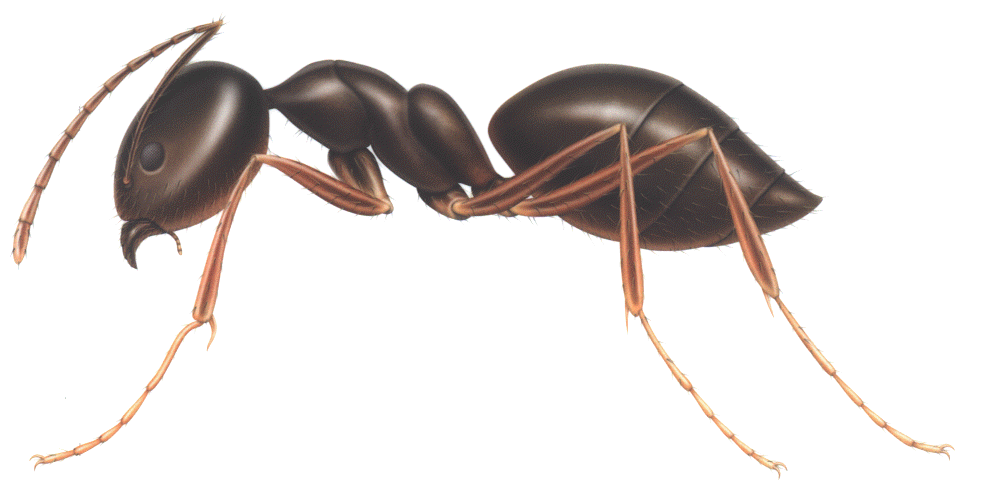
What Do Ants Know That We Don’t?

This from Wired. During the 130 million years or so that ants have been around, evolution has tuned ant colony algorithms to deal with the variability and constraints set by specific environments. Ant colonies use dynamic networks of brief interactions to adjust to changing conditions. No individual ant knows what’s going on. Each ant just…

Constructing Religion without The Social: Durkheim, Latour, and Extended Cognition

Here is the intro to Matthew’s article: Where does thinking happen? The obvious and most common answer is “somewhere inside the head.” After all, this is where the brain is safely housed behind seven millimeters of protective armor. However, despite the instinctive appeal of this response, some theoretical camps have been willing to flirt with…