Browse by:

Getting to the Hayekian Network

Extracts from Troy’s paper: In many ways this paper is necessarily an introduction. I want to introduce away to understand F. A. Hayek’s ideas on both spontaneous orders and the brain by understanding network structures. More, I want to distinguish between networks that emerge top-down in organizations and cellular regulatory networks and those that emerge…

Hayek and Behavioral Economics

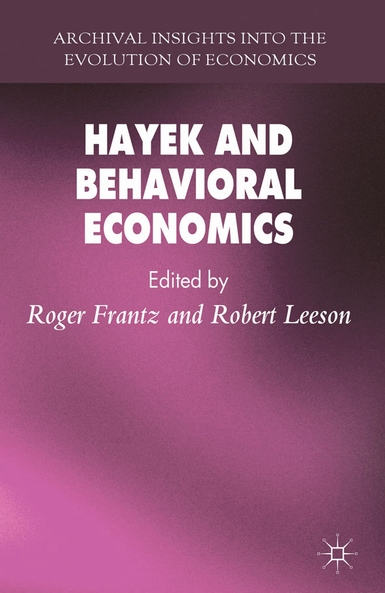
Still on Hayek. Having just received my copy, I thought I’d give it another plug. My chapter Mindscapes and Landscapes: Hayek and Simon on Cognitive Extension is in this collection. The full line-up as follows: Foreword; V. Smith Introduction; R. Frantz & R. Leeson Friedrich Hayek’s Behavioural Economics in Historical Context; R. Frantz A Hayekian/Kirznerian Economic History of…

Beyond Complexity: Can the Sensory Order Defend the Liberal Self?

Here are a couple of extracts from Chor-yung’s paper: Friedrich Hayek’s social philosophy is one of the most systematic and sophisticated among the contributions made by 20th-century liberal thinkers. His defense of the free market and individual freedom and his critique of collectivism of various kinds are mainly based on his epistemological theses, which in…

The Emergence of the Mind: Hayek’s Account of Mental Phenomena as a Product of Spontaneous Physical and Social Orders

Extracts from Gloria’s chapter: Friedrich Hayek’s social theory is well known for his articulation of the paradigm of spontaneous orders that challenges the traditional distinction between what is natural and what is artificial. The problem that Hayek saw is that language and other social objects do not fall under either heading completely. Language is, for…

Hayek’s Post-Positivist Empiricism: Experience Beyond Sensation

Here is Jan Willem Lindemans‘ intro and conclusion to his chapter: The philosophical foundations of Hayek’s works are not beyond dispute (Caldwell, 1992; Gray, 1984; Hutchison, 1992; Kukathas, 1989): was Hayek a rationalist or an empiricist; did he follow Kant or Hume, Mises or Popper? Difficulties arise because these questions touch upon social theory, political…

Hayek, Popper, and the Causal Theory of the Mind

Here are excerpts from Ed Feser’s essay. In late 1952, F. A. Hayek sent his friend Karl Popper a copy of his recently published book The Sensory Order: An Inquiry into the Foundations of Theoretical Psychology. In a letter dated December 2, 1952, Popper acknowledged receipt of the book and responded as follows to what…