Browse by:

Persons and the Extended-Mind Thesis

An extract from Lynne Rudder Baker’s paper: Cognitive scientists have become increasingly enamored of the idea of extended minds. The extended-mind thesis (EM) is the claim that mentality need not be situated just in the brain or even within the boundaries of the skin. EM is the modal claim that it is possible that the…
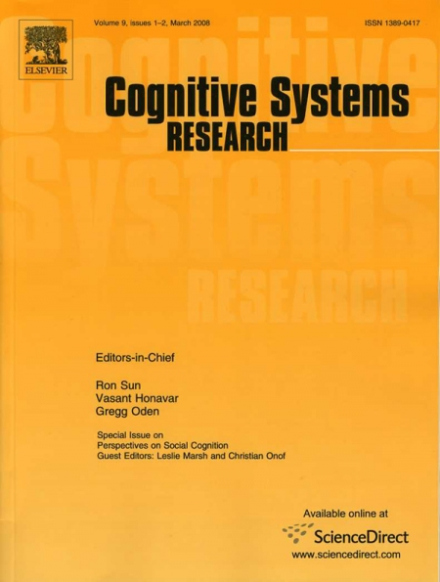
A conceptual and empirical framework for the social distribution of cognition: The case of memory

The power team of  Barnier, Sutton, Harris, and Wilson. Paradigms in which human cognition is conceptualised as “embedded”, “distributed”, or “extended” have arisen in different areas of the cognitive sciences in the past 20 years. These paradigms share the idea that human cognitive processing is sometimes, perhaps even typically, hybrid in character: it spans not only…

Mark Rowlands on the Extended Mind

Here’s Mark’s intro from his paper from a special issue of Zygon on The Extended Mind and Religious Thought from a few years back. The view known as the extended mind, following Andy Clark and David Chalmers (1998), also goes under a number of aliases. Clark and Chalmers themselves also refer to their view as active…

Substituting the Senses

Check out this essay forthcoming from the power team of Clark, Kilverstein and Farina. Sensory substitution devices are a type of sensory prosthesis that (typically) convert visual stimuli transduced by a camera into tactile or auditory stimulation. They are designed to be used by people with impaired vision so that they can recover some of…

Understanding the Internalism-Externalism Debate: What is the Boundary of the Thinker?

Here is a forthcoming paper from the VERY excellent Brie Gertler. Since the work of Burge, Davidson, Kripke, and Putnam in the 1970’s, philosophers of language and mind have engaged in extensive debate over the following question: Do mental content properties—such as thinking that water quenches thirst—supervene on properties intrinsic to the thinker? To answer affirmatively…