The remarkable ‘love story’ between great thinkers Adam Smith and David Hume is told in a new play
As reported in The Scotsman. Tickets. Adam Smithclassical liberalismDavid HumefriendshipScottish Enlightenment
As reported in The Scotsman. Tickets. Adam Smithclassical liberalismDavid HumefriendshipScottish Enlightenment
Adam Smith’s Quiet Christianity — Deidre McCloskey/Adam Smith Understood That We Need Each Other — Vernon Smith/Butchers, Brewers, and Bakers Still Thrive in Urban Marketplaces — M. Nolan Gray/Symposium on Jesse Norman’s Adam Smith: What He Thought, and Why it Matters/Symposium on Jack Russell Weinstein’s Adam Smith’s Pluralism: Rationality, Education And The Moral Sentiments/Propriety and…
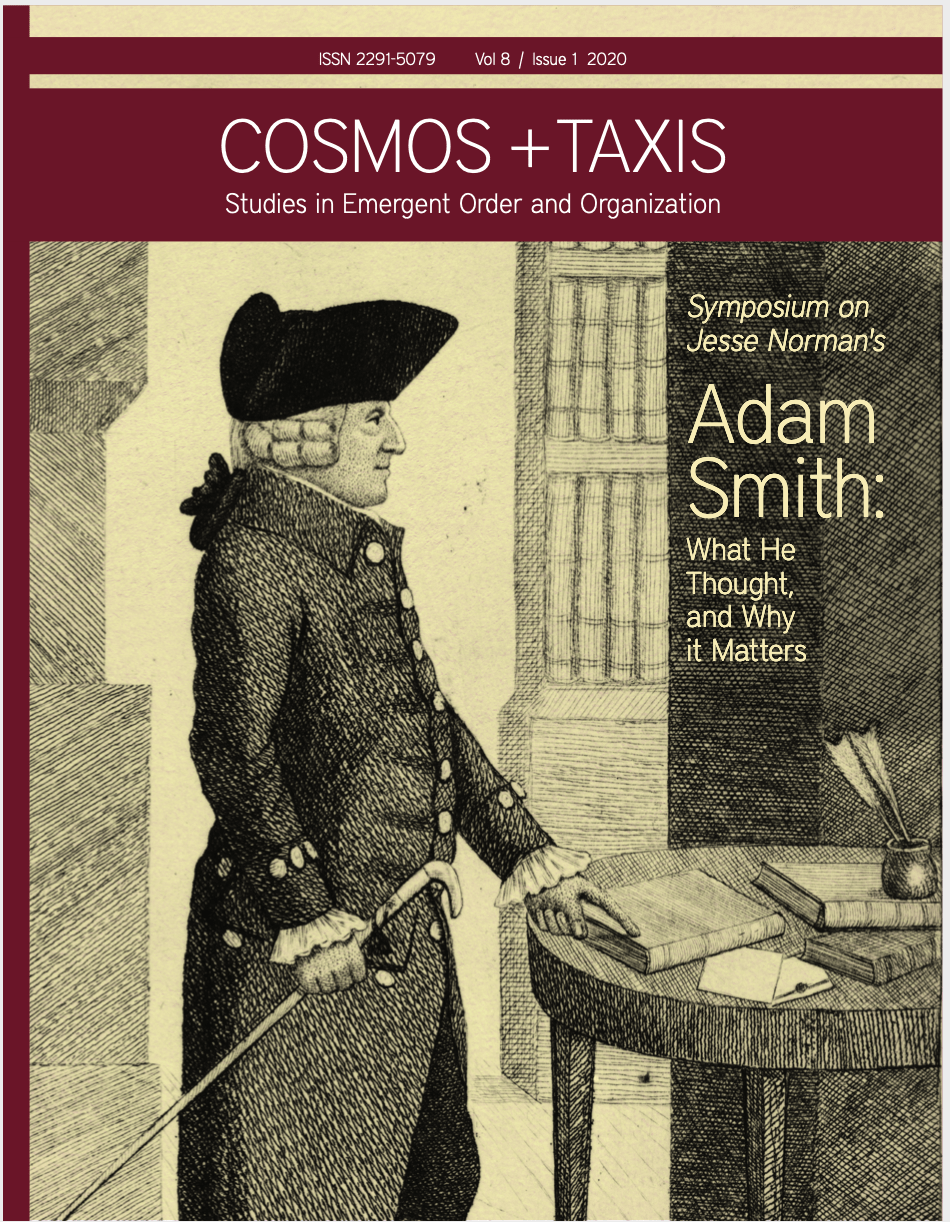
Adam SmithJesse Norman
There was a time when many commentators thought that there was a problem with Adam Smith. The tendency to read Smith’s thought as marred by supposed tensions between the ‘sympathy’ of The Theory of Moral Sentiments (TMS) and the ‘selfishness’ of The Wealth of Nations (WN) has long since been debunked. Smith scholars are coming…
Smith scholarship is split on whether the apparent conflict between self-interest in the Wealth of Nations (WN) and sympathy in the Theory of Moral Sentiments (TMS) indicates an intractable problem or is merely the result of a misunderstanding of Smith’s overall system. This chapter is written as a response both to the believers in das…
The invisible hand means a variety of things to modern writers, who use the phrase loosely to imply the market, the price system, efficiency, laissez-faire, greed is good, and so on (Samuels et. al., 2011; Medema, 2009; Rothschild, 1994). In some circles the invisible hand is referred to with reverence and in others with mockery.…
This chapter discusses Adam Smith’s rhetorical use of the ‘invisible hand’ in the context of his teachings on metaphors as figures of speech in his lectures on Rhetoric (Edinburgh, 1748-51; Glasgow, 1752-64 (LRBL). After Smith died (1790), a strikingly long-period of silence about his three references to an ‘invisible hand’ followed until 1875, when traces…
Is there any reason to devote time or effort to reading (or writing) an additional essay on Adam Smith’s “invisible hand”? Given the plethora of papers (as well as chapters, comments, and asides) dedicated to uncovering, interpreting, explaining, or contextualizing this notable expression, one could be pardoned for responding that, in fact, no such reason…
In the midst of one of the most famous passages in The Wealth of Nations, Adam Smith writes “nobody ever saw a dog make a fair and deliberate exchange of one bone for another with another dog” (WN I.ii.2). In and of itself, this is probably not a noteworthy sentence, but it has always rubbed…
Is the assumption of self-interested behavior assumed in economics at odds with altruism and compassion? I believe that this question—which has been formulated in various ways in the literature for the past two centuries—is the thorn that often turns us away from reconciling the Adam Smith of the Wealth of Nations (hereinafter WN) with the…
 manwithoutqualities